Showing posts with label lens. Show all posts
Showing posts with label lens. Show all posts
Sigma 70-300mm f/4-5.6 SLD DG Macro Lens with built in motor for Nikon Digital SLR Cameras
 05:59 |
  Posted by
yai
Posted by
yai

Technical Details
- 14 Elements in 10 Groups Lens Construction
- 34.3 to 8.2 degrees angle of view
- F22 Minimum Aperture
- 59.1 (150cm) / 37.4 (95cm) Macro Mode Minimum Focusing Distance
- 1 - 4.1 / 1 - 2 Macro Mode Maximum Magnification

I hesitated buying this lens for my Nikon D40X - probably looked at this property six or seven times before they buy. Honestly I was worried about how it is inexpensive. Now, I'm probably very average amateur photographer in that the majority of my pictures are things of the family: children's sports events, holidays, birthdays, etc.. But this does not mean I'm willing to compromise on quality to save a little money, and I know that the Nikon 55-200 is an objective quality.
But I bought based on the review Michael Del Priore (his was the only critical at the time) - I thought at that price (especially compared with the Nikon 55-200), why not give it a shot, and I 'm glad I did.
This is an excellent goal. The autofocus motor is quick and does not chew the battery (I was concerned about that, but I shot about 170 images on my son's games two Saturdays ago and do not use more energy than Nikon 35-70 lens supplied with the unit). Like "cinderoo" I have not had any problems to speak of stabilization or even behind the shutter, while following 12 years old boys run along a field. Perhaps more than one problem with macro photography, but I guess most of the photograph (albeit limited) macro that I'd probably be using a tripod anyway.
Now nobody take me for a professional photographer, but I can tell you that when I shoot pictures with my D40X and the Sigma on my 24 "iMac and the display in full screen, they are * all * I was looking for when I decided to move to an SLR.
But I bought based on the review Michael Del Priore (his was the only critical at the time) - I thought at that price (especially compared with the Nikon 55-200), why not give it a shot, and I 'm glad I did.
This is an excellent goal. The autofocus motor is quick and does not chew the battery (I was concerned about that, but I shot about 170 images on my son's games two Saturdays ago and do not use more energy than Nikon 35-70 lens supplied with the unit). Like "cinderoo" I have not had any problems to speak of stabilization or even behind the shutter, while following 12 years old boys run along a field. Perhaps more than one problem with macro photography, but I guess most of the photograph (albeit limited) macro that I'd probably be using a tripod anyway.
Now nobody take me for a professional photographer, but I can tell you that when I shoot pictures with my D40X and the Sigma on my 24 "iMac and the display in full screen, they are * all * I was looking for when I decided to move to an SLR.
Nikon 35mm f/1.8G AF-S DX Lens for Nikon Digital SLR Cameras

Technical Details
- Engineered for Nikon DX-format digital SLRs - Optical formula optimized for use with Nikon DX-format digital SLRs
- Aspherical lens element - Minimizes coma and other types of lens aberrations, further improving image integrity
- Nikon Super Integrated Coating (SIC) - Enhances light transmission efficiency and offers superior color consistency and reduced flare
- Exclusive Nikon Silent Wave Motor (SWM) - Enables fast, accurate and quiet autofocus
- Close focusing to one foot for creative perspectives and versatility

Being a semi-professional self-proclaimed, I am not exactly a pro, but I'm still demanding when it comes to camera hardware (and software for that matter). I mention this because it is the opinion within the appropriate context.
On the ice ...
First, if a goal of $ 199 Nikon comes around I have two thoughts, "Bravo!" and "seems pretty cheap for Nikon." I was skeptical, but for $ 199 and all the great reviews why not give it a shot? Well, I did.
Amazon is torturing me, B & H teased me, and my local camera shops do not exactly allay my fear that it would be months before I could get my hands on one. Set pre-order at all sites mentioned above my local store came through the first (and for the same $ 199 price tag).
I get home, take it out of the box and the first thing that comes to mind is how it is much heavier than some of the kit lenses I picked up. Yes, it is plastic, but the thing has a different level of the quality of the budget other Nikon lenses / consumer. You can read the other reviews on Amazon and other websites for more details, but the fact is that there is a noticeable difference.
I then put the thing on my camera (meant to put on a first filter) and begin to chatter out there, within, and everywhere in between. The pictures are fantastic, the dim light, in particular. The bokeh is not top notch but for anyone but a pro likely that it will be a good compromise is the price tag 199 is a huge selling point here. And make no mistake, the bokeh is not great, I just see better with more (much more) expensive lenses.
So it's hype? Is a sale of $ 199 Nikon lens, is good enough for the most demanding consumers out there? You betcha, this thing is probably the best buy smart and I've done over the last five years. I have three other lenses and I can say without hesitation 35mm F/1.8 AF-S will be on my camera 90% of the time - if not more - from now.
In closing, if you love photography, but can not afford to drop hundreds, even thousands of dollars on nicer lenses, irritated by the fact that photography in low light with the kit lens does not the case, and want to develop is the goal to achieve.
I promise you, you will not be disappointed.
Good luck!
On the ice ...
First, if a goal of $ 199 Nikon comes around I have two thoughts, "Bravo!" and "seems pretty cheap for Nikon." I was skeptical, but for $ 199 and all the great reviews why not give it a shot? Well, I did.
Amazon is torturing me, B & H teased me, and my local camera shops do not exactly allay my fear that it would be months before I could get my hands on one. Set pre-order at all sites mentioned above my local store came through the first (and for the same $ 199 price tag).
I get home, take it out of the box and the first thing that comes to mind is how it is much heavier than some of the kit lenses I picked up. Yes, it is plastic, but the thing has a different level of the quality of the budget other Nikon lenses / consumer. You can read the other reviews on Amazon and other websites for more details, but the fact is that there is a noticeable difference.
I then put the thing on my camera (meant to put on a first filter) and begin to chatter out there, within, and everywhere in between. The pictures are fantastic, the dim light, in particular. The bokeh is not top notch but for anyone but a pro likely that it will be a good compromise is the price tag 199 is a huge selling point here. And make no mistake, the bokeh is not great, I just see better with more (much more) expensive lenses.
So it's hype? Is a sale of $ 199 Nikon lens, is good enough for the most demanding consumers out there? You betcha, this thing is probably the best buy smart and I've done over the last five years. I have three other lenses and I can say without hesitation 35mm F/1.8 AF-S will be on my camera 90% of the time - if not more - from now.
In closing, if you love photography, but can not afford to drop hundreds, even thousands of dollars on nicer lenses, irritated by the fact that photography in low light with the kit lens does not the case, and want to develop is the goal to achieve.
I promise you, you will not be disappointed.
Good luck!
Nikon 18-55mm f/3.5
Nikon 18-55mm f/3.5-5.6G AF-S DX VR Nikkor Zoom Lens
Technical Details
The Digital SLR Nikon Total Imaging System includes a level of quality from renowned Nikkor optics lens. Ongoing research and development of Nikon's Nikkor lenses can provide ongoing Nikon digital SLR with additional choices and even greater optical performance.
Nikon is pleased to add to the lineup of new AF-S DX Zoom-Nikkor 18-55mm f3.5-5.6G VR, a lens with a built-in Silent Wave Motor and Vibration Reduction (VR). The AF-S DX Zoom-Nikkor 18 - 55mm f3.5-5.6G VR is an affordable and compact, 3x optical zoom lens with amazing versatility. This new lens offers better shooting as the latest addition to the Nikon DX Nikkor lens lineup.
Technical Details
- 18-55mm lens with f3.5-5.6 maximum aperture for Nikon DSLR cameras
- Focal length equivalent to 27 to 82.5mm in 35mm photography
- Features a Silent Wave Motor and and Vibration Reduction (VR)
- 0.28 meter/0.9 foot closest focusing distance throughout the entire zoom range
The Digital SLR Nikon Total Imaging System includes a level of quality from renowned Nikkor optics lens. Ongoing research and development of Nikon's Nikkor lenses can provide ongoing Nikon digital SLR with additional choices and even greater optical performance.
Nikon is pleased to add to the lineup of new AF-S DX Zoom-Nikkor 18-55mm f3.5-5.6G VR, a lens with a built-in Silent Wave Motor and Vibration Reduction (VR). The AF-S DX Zoom-Nikkor 18 - 55mm f3.5-5.6G VR is an affordable and compact, 3x optical zoom lens with amazing versatility. This new lens offers better shooting as the latest addition to the Nikon DX Nikkor lens lineup.
 Labels:
lens,
nikon,
Nikon D300,
nikon D3000,
Nikon D300s,
nikon D60,
Nikon D700,
Nikon D90,
reviews,
tools
|
Labels:
lens,
nikon,
Nikon D300,
nikon D3000,
Nikon D300s,
nikon D60,
Nikon D700,
Nikon D90,
reviews,
tools
|
 0
comments
0
comments
Nikon 18-200mm f/3.5-5.6 G
Nikon 18-200mm f/3.5-5.6 G ED-IF AF-S VR DX Zoom-Nikkor Lens
Technical Details
Product Description
This Zoom-Nikkor lens offers broad 18 - 200mm focal range for use in a variety of situations (equivalent to an objective 27-300 35mm format). 11x zoom coverage offers a perfect compact and lightweight, one lens solution. VR II system offers the equivalent of using a shutter speed 4 stops faster.Two ED glass and three aspherical lens elements minimize chromatic aberration, astigmatism and other forms of distortion while ensuring high resolution and contrast. Nikon Super Integrated Coating (SIC) offers superb color reproduction while minimizing ghosting and lens flare.The incorporates a SWM (Silent Wave Motor) for fast development and peace offers high-level optical performance designed for use exclusively with Nikon DX format lens employs seven digital.The blade rounded diaphragm opening that achieves a natural blur for out-of-focus elements, it allows focusing as close as 50 cm (20 inches) on the topic its entire length range.M / A mode is delivered to the rapid switching between autofocus and manual focus operation. Flower-shaped Lens Hood HB-35 significantly reduces stray light.

Technical Details
- High-ratio, 11x zoom lens and 18-200mm focal range
- VR II Vibration Reduction technology provides a four-steps-faster shutter speed
- Lens incorporates two ED glass and three aspheric lens elements
- Delivers high-resolution and contrast, outstanding image quality, and fantastic photographic versatility
- AF-S Silent Wave Motor provides fast quiet autofocusing, and M/A mode makes it easy to switch from auto to manual focus
Product Description
This Zoom-Nikkor lens offers broad 18 - 200mm focal range for use in a variety of situations (equivalent to an objective 27-300 35mm format). 11x zoom coverage offers a perfect compact and lightweight, one lens solution. VR II system offers the equivalent of using a shutter speed 4 stops faster.Two ED glass and three aspherical lens elements minimize chromatic aberration, astigmatism and other forms of distortion while ensuring high resolution and contrast. Nikon Super Integrated Coating (SIC) offers superb color reproduction while minimizing ghosting and lens flare.The incorporates a SWM (Silent Wave Motor) for fast development and peace offers high-level optical performance designed for use exclusively with Nikon DX format lens employs seven digital.The blade rounded diaphragm opening that achieves a natural blur for out-of-focus elements, it allows focusing as close as 50 cm (20 inches) on the topic its entire length range.M / A mode is delivered to the rapid switching between autofocus and manual focus operation. Flower-shaped Lens Hood HB-35 significantly reduces stray light.
Nikon 14-24mm f/2.8G ED AF-S

Nikon 14-24mm f/2.8G ED AF-S Nikkor Wide Angle Zoom Lens
Technical Details
- AF-S Nikkor 14-24mm f/2.8G ED lens
- 21-36mm Effective Focal Length with APS-C Sensor Cameras
- Ideal for Wide-angle Shots of Landscapes and Scenery
- Lens Construction: 14 Elements in 11 groups
- Contains Two ED (extra-low dispersion) Lens Elements for High Resolution and Contrast
Product Description

PRODUCT FEATURES: Fast, ultra wide-angle AF-S zoom lens optimized for edge to edge sharpness on both Nikon FX and DX format image sensorsEnhanced optical formulas, engineered to produce exceptional sharpness, contrast and color , rendering outstanding image integrityTwo ED (extra-low dispersion) elements and PGM aspherical lenses control chromatic aberrations while enhancing sharpness and contrast, even at the widest aperture settingsExclusive nanocrystal reduces ghosting and reflections more, even for larger image clarityNikon Silent Wave Motor (SWM) enables ultra-high rapid development with exceptional accuracy and powerful super-quiet operationInternal Focus (IF) provides fast and silent auto focus without changing the length of the lens, while retaining subject-working distance through the focus rangeRugged and construction professionals from dust and moisture grade resistanceM / A Focus Mode switch enables quick response to changing situations between Auto and operation Manual focus
Tiffen 58mm UV Protection Filter
Technical Details
The product felt strong, solid and well made. The glass was clear with no visible tint or imperfections. Although this and another filter (same type different size) both arrived with stains on the glass. The smudges were fairly easy to wipe, but I suspect the items are not cleaned before packaging, or I have received the returned item someone. However, I had to return this product b ecause they do not contain any coating anti-glare/reflective them. When shooting towards a light source (lamp, TV, sun, etc) a green reflection of the light source appears on the recorded image. The green reflected image was caused by a reflection bouncing off of my lens green tinted anti-glare that I came back to the camera by this filter. If your goal is not coated with an anti-glare, the result will be even worse.
Instead I picked up a Quantaray filters local Wolf Camera that have been coated with anti-glare. They cost only a little more, and the green reflection is now gone. Make sure you are looking for a filter with anti-glare
More>>>

- Most popular protection filter
- Provides basic reduction of ultraviolet light
- 58mm diameter
- Helps eliminate bluish cast in images
The product felt strong, solid and well made. The glass was clear with no visible tint or imperfections. Although this and another filter (same type different size) both arrived with stains on the glass. The smudges were fairly easy to wipe, but I suspect the items are not cleaned before packaging, or I have received the returned item someone. However, I had to return this product b
ecause they do not contain any coating anti-glare/reflective them. When shooting towards a light source (lamp, TV, sun, etc) a green reflection of the light source appears on the recorded image. The green reflected image was caused by a reflection bouncing off of my lens green tinted anti-glare that I came back to the camera by this filter. If your goal is not coated with an anti-glare, the result will be even worse.Instead I picked up a Quantaray filters local Wolf Camera that have been coated with anti-glare. They cost only a little more, and the green reflection is now gone. Make sure you are looking for a filter with anti-glare
More>>>
Nikon 55-200mm f/4 customer review
Nikon 55-200mm f/4-5.6G ED IF AF-S DX VR
 [Vibration Reduction] Zoom Nikkor Lens
Ownership of my Nikon back more than 30 years when the cameras were made of metal and an accountant with a few lenses tested your endurance.
Times have changed. There is hardly a camera in metal to be found and you can carry a bag full of equipment in one hand. The Nikon 55-200mm f/4-5.6G ED IF AF-S DX VR Zoom Nikkor is the last light from the heavy industry of the camera.
Plastic building into its lens mount. This thing looks and feels like the label must say Fisher Price and not Nikon. However, appearances can be deceptive as I soon discovered.
My only reason to buy this objective was that I needed to fill a void in my bag until I saved enough for a 70-200mm f2.8. I did not intend to keep the 55-200 VR, 70-200 once arrived.
After shooting 55 to 200 for a few months I've come to appreciate what it can do. It is limited to use in a good light because even VR can not change the laws of physics. In this case, it is not even the VR-II underway but that the original VR Nikon developed several years ago.
With adequate lighting and good technique, the 55-200 is capable of very good performance. No, this is not as sharp as the contrast and 70-200. It also does not survive the weather or a few solid blows that business use would expose it.
When 55-200 excels is in its portability and performance above average. Journey To walk it would be hard to beat this target if used within its limits. I use mine on a D80 and have no problem getting excellent 13x19 "prints.
As a bonus, it works very well with the Nikon lens CL3T close double and a macro zoom. Again, this is not a substitute for a real macro zoom like the Nikon 70-180, but it is not intended for.
Since my original review of this objective, I must admit I had a lot more than my money out of him. Instead of selling, I'll keep it and use it when my 70-200 is just big and heavy to carry.
If you're on a budget or just want a lens, Nice light in this range, take a look, the Nikon 55-200mm f/4-5.6G ED IF AF-S DX VR. Like me, you may be surprised what it can do.
Nikon 55-200mm f/4-5.6 review
Nikon 55-200mm f/4-5.6G ED IF AF-S DX VR [Vibration Reduction] Zoom Nikkor Lens

Technical Details
- 55-200mm zoon Nikkor lens with f/4-5.6 maximum aperture for Nikon digital SLR cameras
- 2 extra-low-dispersion (ED) glass elements for minimized chromatic aberration and superior optics
- Super-integrated coating minimizes ghosting and flare for more vivid images in dim lighting
- Silent Wave Motor produces quick and quiet high-speed autofocusing; weighs 9 ounces
- Measures 2.7 inches in diameter and 3.1 inches long; 5-year warranty
Product Description
55-200mm f/4-5.6G ED AF-S DX VR Zoom-Nikkor 35mm equivalent of 82-300mm * Vibration Reduction allows further discussion shots with exposure times longer (up to three speeds of 'Shutter slower) * Silent Wave Motor for fast, quiet focusing * ED (Extra-low Dispersion) glass lens for superior optical performance * Attachment / Filter Size: 52mm *
Nikon 35mm f/1.8G Details

Technical Details
- Engineered for Nikon DX-format digital SLRs - Optical formula optimized for use with Nikon DX-format digital SLRs
- Aspherical lens element - Minimizes coma and other types of lens aberrations, further improving image integrity
- Nikon Super Integrated Coating (SIC) - Enhances light transmission efficiency and offers superior color consistency and reduced flare
- Exclusive Nikon Silent Wave Motor (SWM) - Enables fast, accurate and quiet autofocus
- Close focusing to one foot for creative perspectives and versatility
More>>>
Product Description

With a compact design and lightweight, the AF-S DX NIKKOR 35mm f/1.8G provides the capability of reproduction and high image quality for which Nikkor lenses are famous at an affordable price. The SWM ring type offers a quiet AF operation. Although all lens groups shift during focusing, the front element and filter mount does not rotate and the barrel length does not change, which is useful when using the filter mounted SB-R200 Wireless Remote Speedlight units.
The AF-S Nikkor 35mm f/1.8G DX optical design enables a different look and feel of pictures taken with zoom lenses, and its dimensions are ideal for snapshots discrete and landscape shooting with a picture angle that approaches to the human eye. Rounded diaphragm opening its seven laminated, out-of-focus elements appear more natural. When mounted on a DX format digital SLR, the picture angle is the focal length equivalent to 35mm to 50mm.
The AF-S NIKKOR 35mm f/1.8G has two focus modes, M / A (manual override autofocus) and M (manual focus). The M / A mode enables instant switching to manual operation during AF. The lens also has a rubber seal to minimize entry of moisture around the mountain and can concentrate up to 0.3 meters (0.98 m).
AF-S DX Nikkor 35mm f/1.8G Lens Highlights

With a compact design and lightweight, the AF-S DX NIKKOR 35mm f/1.8G provides the capability of reproduction and high image quality for which Nikkor lenses are famous at an affordable price. The SWM ring type offers a quiet AF operation. Although all lens groups shift during focusing, the front element and filter mount does not rotate and the barrel length does not change, which is useful when using the filter mounted SB-R200 Wireless Remote Speedlight units.
The AF-S Nikkor 35mm f/1.8G DX optical design enables a different look and feel of pictures taken with zoom lenses, and its dimensions are ideal for snapshots discrete and landscape shooting with a picture angle that approaches to the human eye. Rounded diaphragm opening its seven laminated, out-of-focus elements appear more natural. When mounted on a DX format digital SLR, the picture angle is the focal length equivalent to 35mm to 50mm.

The AF-S NIKKOR 35mm f/1.8G has two focus modes, M / A (manual override autofocus) and M (manual focus). The M / A mode enables instant switching to manual operation during AF. The lens also has a rubber seal to minimize entry of moisture around the mountain and can concentrate up to 0.3 meters (0.98 m).
AF-S DX Nikkor 35mm f/1.8G Lens Highlights
- Fast, f/1.8 objective is ideal for low light conditions, travel, portraits, environmental and general photography
- Designed for Nikon DX format digital SLR, the AF-S DX NIKKOR 35mm f/1.8G target renders a picture angle approximating the angle of view of a classic standard 50 mm lens on a Nikon digital SLR camera or a FXformat 35 mm film camera
- Aspherical lens elements minimize coma and other types of optical aberration, further improving image integrity

- Nikon Super Integrated Coating (SIC) improves the efficiency of light transmission and offers color consistency and reduced flare
- Exclusive Nikon Silent Wave Motor (SWM) enables fast, accurate and silent autofocus
- Close focusing to 1 foot for the prospects creative and versatile
- Rounded 7-opening of the diaphragm blade makes out-of-focus elements appear more natural
- Accepts 52 millimeters of attachment filtering

Nikon 50mm f/1.8D AF Nikkor Lens Details
Technical Details
- High-speed normal lens
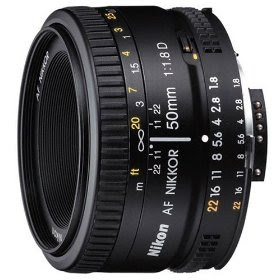
- Great for travel and for shooting full-length portraits in available light
- Distortion-free images with superb resolution and color rendition
- Provides high-contrast images even at maximum aperture
Product Description
The Nikon AF Nikkor 50mm F/1.8D is a high-performance lens with the following specifications: Lens Construction: 7 elements in 6 groups Closest Focusing: 045m/1.5ft. Filter Size: 52mm Dimensions: 2.5 x 1.7 in. Weight: 7.9oz. Lens making is an art - Nikon Nikkor optics artisans craft with the finest materials, taking pride in adding their intellect and technique to bring the world's finest lenses to life. They push the leading edge of the lens to do more and more difficult in their effort to provide the glass "that makes the world's largest pictures.PRODUCT FEATURES: D-type lens design provides distance information as part of flash and ambient processes exposure to light; Classic normal lens provides speed and compact design, multi-layer coating minimizes flare and ghosting; Exceptionally lightweight and compact - ideal for travel photography; stops to f/22 for excellent depth-of - control field.
Customer Reviews
I do not even know where to start. This lens produces sharp pictures and great color and contrast. And for its price (which does not even know where to start. This lens produces sharp images and great color and contrast. And for its price (which seems to climb recently), is worth more than 5 star rating. I initially achieve this goal due to lack of light and action sport photography (as this lens is known to be one of the lenses as fast with his brother 50mm f/1.4), but I also discovered that this objective is also perfect for the portrait and other general purposes (macro, etc.). This is definitely a goal very versatile.
As far as I want to encourage everyone to buy once this goal, let me quote some of the limitations that you would see (which I think will be useful to pass before deciding to buy this lens):
First, being a primary objective, you need to move his feet much to compose the image. If you are used to zoom, do not underestimate this limitation. It takes me a little 'getting used to it, and sometimes I still find people looking at me wondering why I'm going back and forth. The good news is that most of the time, do not think I'm strange, but they are actually asking if I am a professional photographer.
Secondly, the focal range of 50mm, which is considered the normal lens and great portrait lens. but on many digital SLRs, which is not full frame (unless you have a full frame DSLR like the Nikon D700 or D3, then 50 mm and 50 mm), this goal becomes an equivalent of 75 millimeters, which is the boundary of a short tele lens. I really like the equivalent of 75 millimeters although I often have to go back when you take pictures of a group of people.
Thirdly, in some cases auto focus may not be able to focus (which is common to many others too slow). It 'difficult for the autofocus to lock it points to a wall which has a color (usually white or black), or a clear sky (day or night). This kind of sense to me really. In these situations the AF assist light does not help so you can opt for manual focus or set the focus at infinity when you can not find focus lock on scenic / landscape or sky photography. So far I have many problems with the autofocus.
Sharpens, as we pause to af/2.2 of/2.5. I actually use f/1.8 most of the time and the results are still beautiful. Personally, I prefer to use the setup for the opening of f/1.8 stopped down (eg to f/2.8) and compensate with higher ISO setting which often gives me grainy photos. But if the object is not moving (static) then it is better to stop up to 2.8 or more.
If you're wondering whether you should get a fast lens or a lens with VR (Vibration Reduction), here's my take: In general, VR helps a lot (since it reduces camera shake) and produce a better / sharper picture the equivalent lens without VR (especially if the object is static). If the object is moving (sports / action) then VR feature alone does not help (depending on how fast the object is moving and how much light is available), and a fast lens, often turn out to be a solution much better, even without VR feature as it will allow much faster shutter speed to freeze motion. Using tripod (and a remote control) will replace the need for VR. In general I would recommend getting a fast lens with VR (and usually expensive) as the VR 70-200 mm f/2.8, but if you can get it for one or the other, then discover that what you want to use the lens for and then use the guidelines outlined qui.h seems to climb recently), it is worth more than 5 stars rating. I initially get this lens for low light action and sport photography (as this lens is famous for being one of the fastest lens together with its brother 50mm f/1.4), but I also found out that this lens is also perfect for portrait and other general purposes (macro etc). This is definitely a very versatile lens.
As much as I want To encourage everyone to buy this lens right away, let me mention some of the limitation that you would see (which I think will be helpful to go over before Deciding to buy this lens):
First, being a first lens, you will need to move your feet a lot to compose your picture. If you are used to zoom lens, do not underestimate this limitation. It takes me a while to get used to it, and sometime I still find people looking at me wondering why I am moving forward and backwards. The good news is that most of the time, they do not think I'm weird, but they are actually wondering if I'm a professional photographer.
Secondly, the focal range of 50mm, Which is considered the normal lens and great for portrait lens. But on many DSLRs Which is not full frame (unless you have a full frame DSLR like the Nikon D700 or D3, then 50mm is 50mm), this lens become a 75mm equivalent Which is on the border of a short tele lens. I actually like the 75mm equivalent though I often have to move backwards when taking picture of a group of people.
Third, in some situation the autofocus might not Able to focus (which is common for many other lens too). It is hard for the autofocus to lock when aiming at a wall that is one color (usually black or white), or on a clear sky (day or night). This kind of makes sense to me actually. In these situations the AF assist light does not help either so you can opt for manual focus or set the focus to infinity when you can not find focus lock on scenic / landscape or sky photography. So far I do not have many problems with the autofocus.
Sharpness increases as you stop down to f/2.2 or f/2.5. I actually use f/1.8 most of the time and the results are still nice. Personally, I'd rather use f/1.8 aperture settings than stopped down (eg to f/2.8) and compensate with higher ISO settings Which gives me often grainy picture. But if your object is not moving (static) then it is better to stop down to f/2.8 or more.
Whether you are wondering if you should get a fast lens or a lens with VR (Vibration Reduction), here's my take: In overall, VR does help a lot (as it will reduce camera shake) and will produce better / sharper picture than equivalent lens without VR (especially if the object is static.) If the object is moving (sports / action) then VR feature alone might not help (depending on how fast the object is moving and how much light is available), and a fast lens often end up being a far better solution, even without VR feature as it will allow much faster shutter speed to freeze motion. Using tripod (and a remote) will substitute for the need of VR feature. In general I would recommend getting a fast lens with VR feature (and usually it is expensive) such as the 70-200 f/2.8 VR, but if one can only get for one or the other, then find out what do you want to Use the lens for and then use the guideline mentioned here. More>>>
Subscribe to:
Posts (Atom)